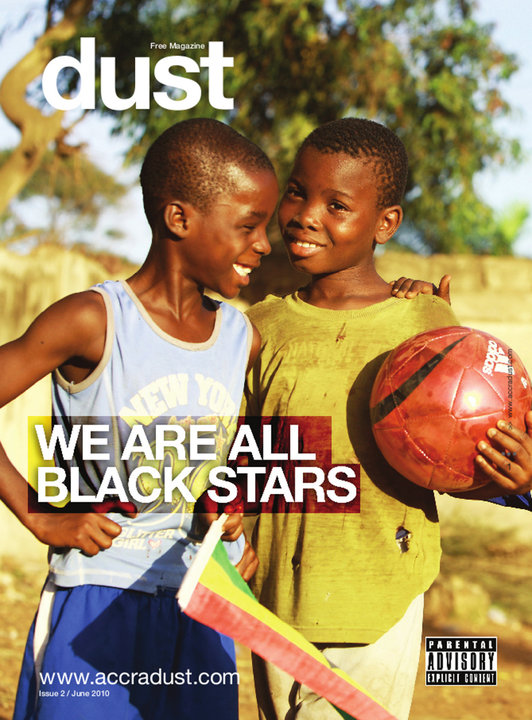
One of my favourite bloggers recently asked his Facebook friends whether not supporting the Black Stars makes you unpatriotic. The obvious answer is no…. but in giving it some thought, I drew some interesting conclusions. As part of my MA, I studied the idea of the nation-state. Kindly bear with me as I flex smaaall…
In simple terms, a nation is a relatively large group of people who have a shared history and certain shared norms and cultural traits. The State – on the other hand – consists of the structures placed on top of the nation: things like an Executive, a Judiciary, laws, enforcers of those laws, etc.
The Nation-State in its modern sense is supposed to have started in Europe and spread through the world when Europeans hopped on their ships and forced it onto other people as a way of organizing and dominating them. That’s what ‘civilization’ was about: making people ‘civil’ enough to be controlled.
That said, the first paper I got an A for on the course was one in which I successfully argued that Asante was a full nation-state before the Europeans came to Africa. It had all the characteristics of a nation-state. There’s even a legend of how – after being told of how her emissaries were welcomed and escorted by armed guards, introduced to the Asante council of state and eventually to the Asantehene – the English Monarch (I think it was Victoria) asked what exactly the British intended to do with them considering they were already a civilized nation-state. But I digress…
The key thing to remember is that the Nation-State is a mostly artificial construct, especially here in Africa where our boundaries were drawn up by colonial powers. To hold together, a nation needs symbols of nationhood: things which its citizens all share in common, evoking a certain passion within them that supercedes their differences…
… like in those ’80s action films I watched in Mfansipim where the dying, defeated American soldier would use the last reserves of his energy to lift his head, see the American flag flying above the embassy not too far away and suddenly be filled with enough strength to use his bare fists to obliterate an entire Vietnamese army. That kind of passion.
What do we have in Ghana that comes remotely close to that? A symbol of Ghanaianness that evokes so much within us that it erases all our differences – tribal, religious, whatever – and brings us all together. The flag? The national anthem or the Pledge? Not since 6th March 1957. Independence Day? It’s (sadly) become just another holiday. Elections? Passionate, yes, but in a divisive manner. Passing through immigration with a Ghanaian passport? No. Religion? Don’t even go there: I’ve heard too many conversations in which Christians say the most ignorant things about Muslims and vice versa.
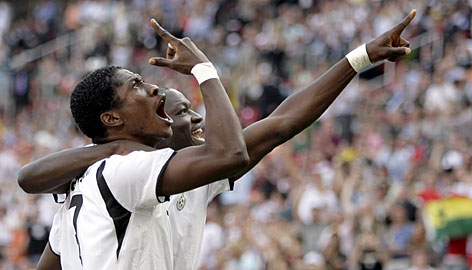
One of the only times when Ghanaianness actually means something is in the moments just after the Black Stars have scored a goal. In those moments, we are all Ghanaian. Nothing else. No tribe matters. No religion matters. Nothing else matters. We all celebrate the same thing, with ridiculous, raw emotion. As one.

It sounds crazy, but I think the Black Stars help define Ghana’s sense of nationhood. They make Ghana – which is really just an artificial merging of so many people who would not have been had it not been for colonial powers – into a real idea.
So does not supporting the Black Stars make you unpatriotic? I wouldn’t go that far. Just because supporting them can be described as a show of patriotism doesn’t automatically mean that not supporting them is unpatriotic. This is a (relatively) free country and everyone is entitled to their opinion. I’ll say this though:
I’m not an avid football fan. It’s not that I’m not interested. It’s that I’m just not passionately interested. I can watch a match, but I won’t follow a team as religiously as the average Ghanaian male (or female: our women are way more into soccer than their British counterparts) follows Chelsea or Man U all the way through a season, shedding grown-folk-tears whenever Rooney or Essien scores a goal or pulls a ligament.
That changes once every four years though. Specifically, whenever the Black Stars are competing in the World Cup. Whenever Asamoah-Gyan scores another penalty (sigh…) and my scream of “GOAL!” joins a cacophony of others’, we are suddenly all just Ghanaian. All the things that divide us melt away for at least that moment.
As part of a collective at least, rarely is the average Ghanaian more patriotic.
Raising Attackers
A Scottish friend of mine bought himself a Black Stars jersey during the last World Cup, but gave it to me after we got kicked out. He told me that if Ghana wants to win the World Cup, we should forget about African unity and focus on merging with just La Cote d’Ivoire so we could count Drogba as one of us. His basic point was that we need strikers. He was right.
Ghana has great defenders and midfielders. I love Asamoah-Gyan – he tries… hard – but we need strikers capable of playing those powerful from-halfway-across-the-pitch kind of blinding shots that goalkeepers can barely keep in their hands, much less catch. Not our current softly-softly-half-passes-to-the-opposing-goalkeeper.
I heard a theory recently about how those games of football we played as kids – with the balls made from putting loads of rubber bands together – are great at honing defensive and midfield skills… but not attackers. I don’t know if this is true: I’m pretty sure they play the same thing in Brazil, for example. I’m no expert but here’s a simple suggestion for the GFA/Ministry of Sports:
Encourage a game for kids in which the aim is to score from outside the penalty box. Not penalties: full play, but any goal from inside the box is disallowed. That’s it. Make a reality show out of it or a tournament or something. Start now and in two or three World Cup’s time, we’ll probably have good strikers.
Because this awoof only-score-from-penalties-goal-system we are trying out will only get us so far.
 Kobby Ankomah Graham